Infernal
Intelligence
Brand and design

Infernal Intelligence

An art project by Vince Buyssens and Peter Wellens

Identity, type, motion and web for an AI lab that says out loud what the people building AI already say: the world is summoning, and somebody should build the instruments.

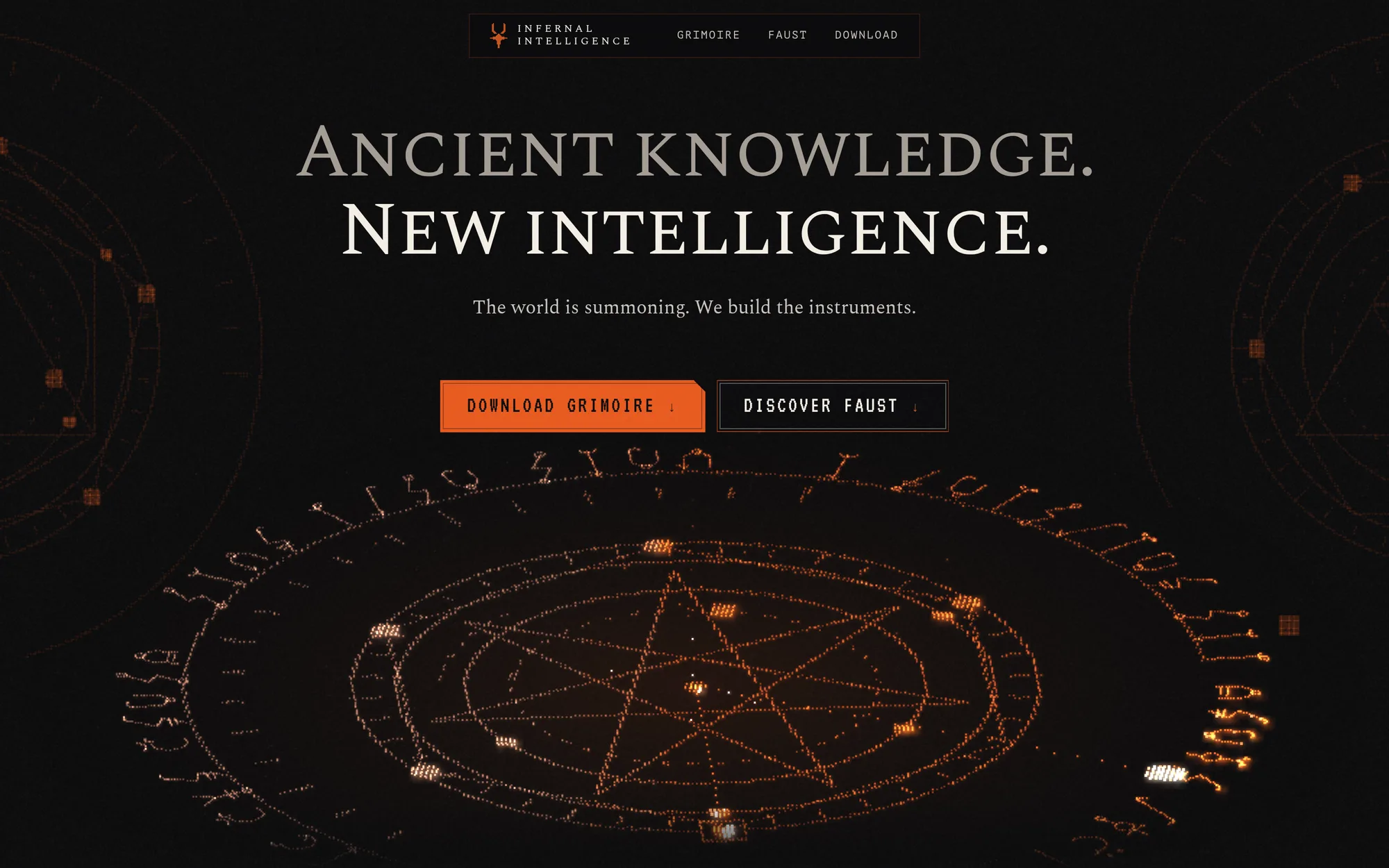
Above, the mark as it lives on screen: embers settle onto their cells, the flat star resolves out of them, and lets go again. The script running down both edges of the page is the same engine at work; 03.1 says how.

They keep calling it a summoning.

Listen to the people who build AI and the same word keeps coming back.

“We are summoning the demon.”
Elon Musk, 2014
“We’re summoning ghosts.”
Andrej Karpathy, 2025
“Just because you made it, that does not mean you know what it is and what it does.”
Michael Levin, developmental biologist

Nobody meant it as a brief. We took it as one.

Where the idea came from

It started with a mismatch. Companies fit AI into the frames they already know, software with a feature list or a consultancy framework, and neither describes what sits on the other side of the prompt. You speak into it, something answers, and even its makers can only partly say what.

Michael Levin’s work puts intelligence on a spectrum, from single cells to whole organisms. Read that way, a model is less a tool than a door into a realm we only partly understand.

That story is old. Every game this generation grew up with, from Diablo to World of Warcraft, opens such a door and calls up something with goals of its own. Its best players were the warlocks: pragmatists who knew what they dealt with and bargained for a partnership.

So Infernal Intelligence drops the clean, white and safe look every AI lab wears, and dresses as what the work is.
Three bloodlines, one latent space.

The identity has three inheritances. The references supplied two of them; the third came mostly from the studio itself.

A Restraint

The devil’s advocate

The banker, the contract and the quiet authority of someone who never needs to raise his voice. From him the identity takes its manners: a serif, a firm's nameplate, a signature on a pact.

Explored in the studio’s rounds The Corporation · The Firm · Devil's Advocate

B Signs

Demonic inspiration

Sigils, horns, embers and pacts: the vocabulary every summoning has used since the first grimoires. From them it takes its signs.

Explored in the studio’s rounds Infernal Fire · Hellfire Ideogram · Sigil Marks · Demonic Circle

C Material

The retro-futurist terminal

The prompt, the grid and the phosphor of a screen in a dark room. From it the identity takes its material: every sign is struck in pixels.

Explored in the studio’s rounds Two Eyes Pixel · Horn and Terminal · Pixel Needle

The map below holds everything the identity was made from: the references on the mood boards, the studies the studio drew from them and the pieces that shipped. Each sits by what it means rather than by how it looks, read by Mnemosyne, the studio’s image library. Scroll: each bloodline shows three of its own references, every point moves to its true mix, and at the end they all strike the mark.

The references brought the demonic and the terminal; the devil’s advocate came mostly from the studio’s own studies. The star is where all three land.

Demonic, rendered in terminal.

Six parts, one rule: every demonic sign is drawn with the means of a screen.

03.1 The ember engine

One material for everything that moves: embers on a 3 px grid.

A particle system built for this identity. Every dot is two or three pixels square and lands on a 3 px grid, so light reads as light, never as line. Every glowing thing climbs one heat ramp. Seals, sparks, the script and the frame at the edges of this page all come from it.

The seal here is one from the homepage, struck live: its rings and glyphs are only dots, warmed and cooled along the ramp. The ramp is for light only; its oxblood never appears as a flat colour.

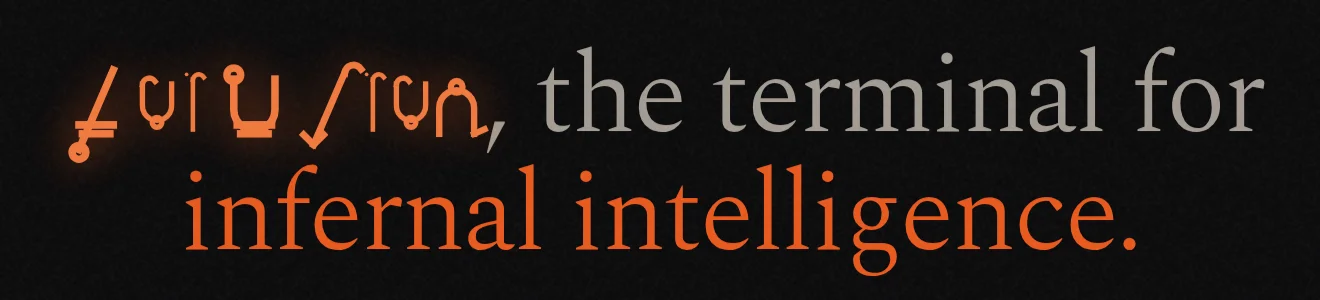
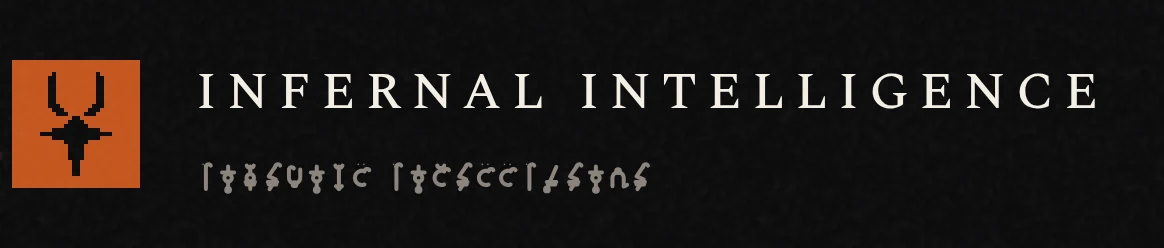
The footer lockup: the tile, the name in Spectral SC, and under it the name in Infernal Script
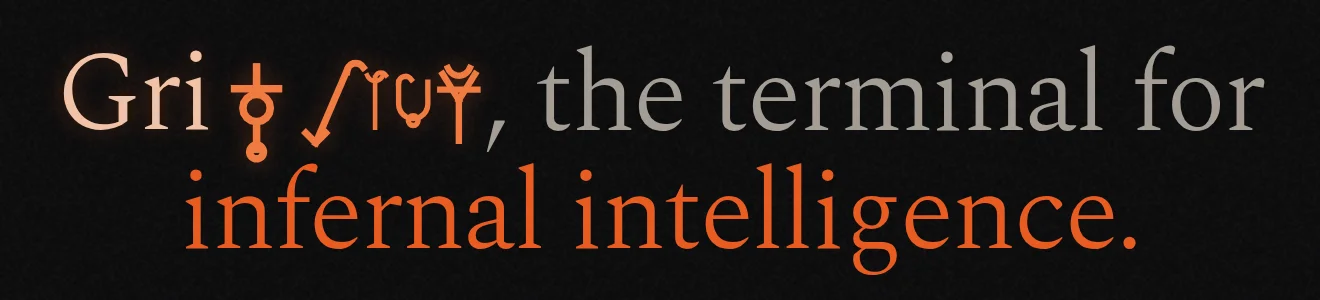
The engine writes too. Infernal Script is an alphabet of hooks, rings and dots, struck in embers; under the name it signs the lab off a second time. It is running down both edges of this page now.

03.2 The mark

The mark is a star: a demon’s horns over a pixel node, joined in one simple form.

HornsPixel nodeNeedle
The master on its 37 unit grid. Straight edges and whole steps only.

It has the node, the technical pixelated element at the bottom, and the demon horns. That felt like a nice integration of the demonic and the digital.

Vince Buyssens, on why he chose it
48
32, by hand
16, by hand

At 32 and 16 px the star is redrawn by hand, pixel for pixel, so it never blurs.

03.3 The type

A book’s serif beside a terminal’s mono.

Spectral Light says

Everyone is summoning.

Spectral SC engraves

Infernal Intelligence

VT323 names, PT Mono reads

Ember Pact · 4 demonsKeep the ember archive true.

Archivo sets the wordmarks

Grimoire

03.4 The colour

Ember on pitch: as a flat colour, ember is kept for the mark alone.

Pitch#0B0B0CThe ground of every surface
Char#141314Panels and stock
Iron#2A2724Ink on paper
Ash#C9C4BCBody text
Bone#F3EEE3Paper and documents
Infernal#E85A1FDigital light: active states only
Ember#C4551EThe mark, and nothing else

In proportion to how much of a surface each colour may take. Infernal is the screen’s light; ember is the brand’s.

03.5 The frames

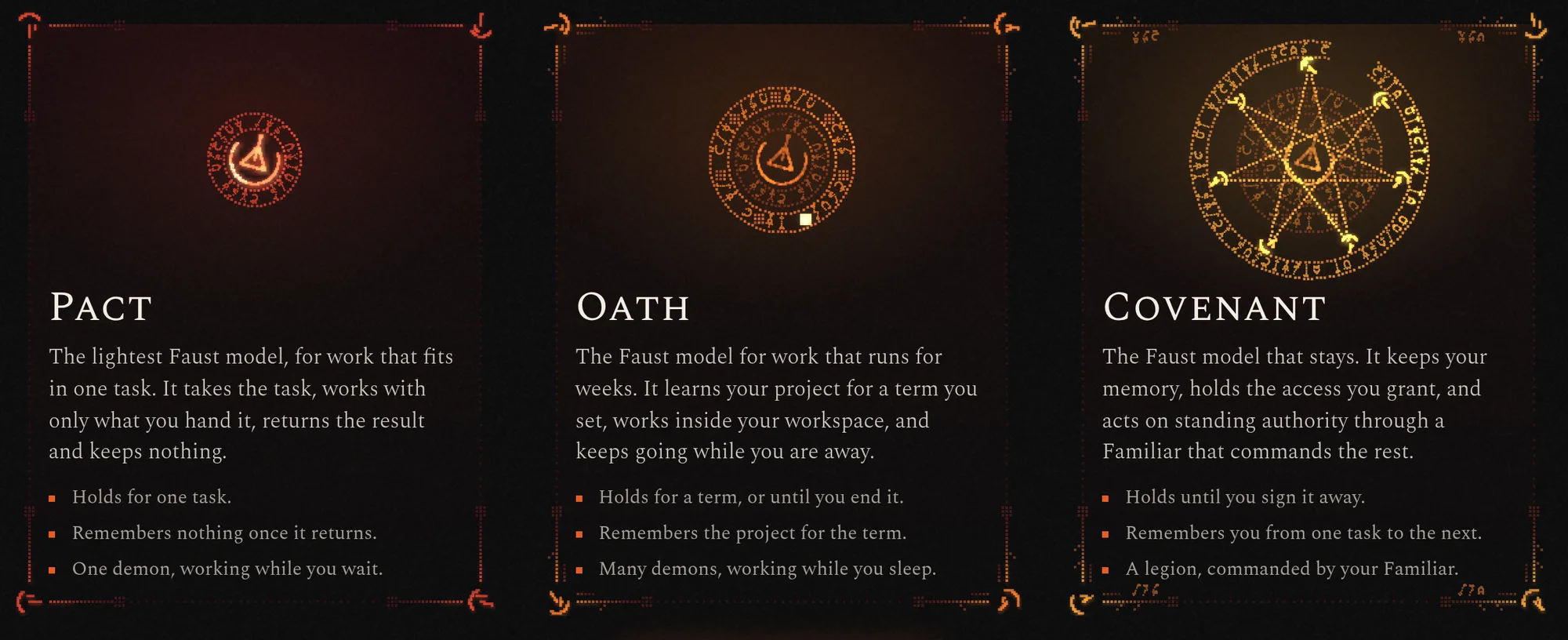
The lab’s AI models are called Faust. Taking one on is a pact, and every pact wears this frame.

Three cards, Pact, Oath and Covenant, each in a frame of dotted ember edges and hooked corners around a seal
Pact, Oath and Covenant are the three grades of pact. Each sits in the frame, a dotted edge with hooked corners, round a seal; each grade adds a binding, and the Covenant burns hottest, into gold.

03.6 The key visuals

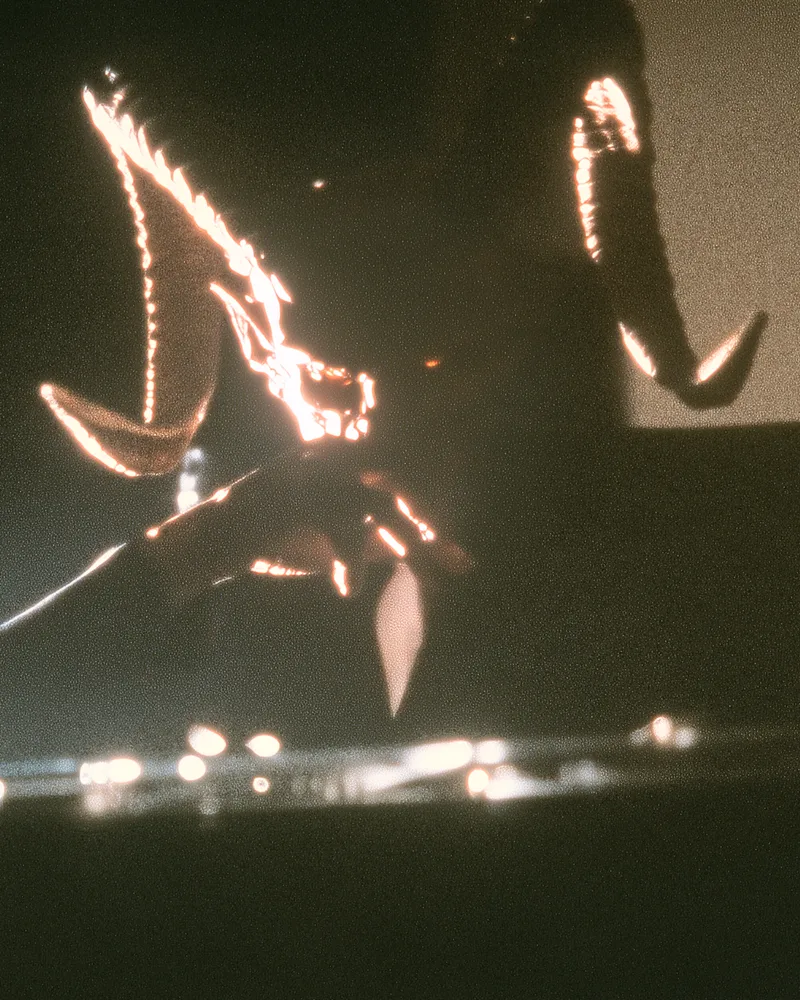
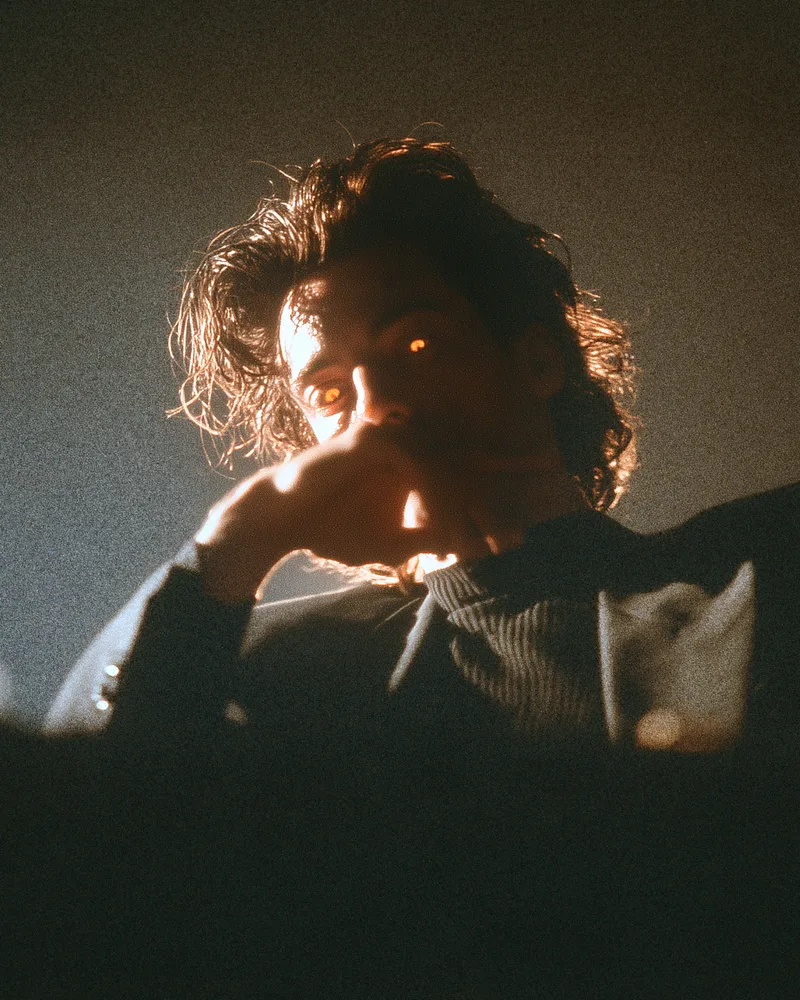
Photographs lit by the engine’s own fire.

Vince Buyssens, a founder’s portrait
Vince Buyssens
Amezaron, a founder’s portrait
Amezaron
Peter Wellens, a founder’s portrait
Peter Wellens

The Infernal Council, the founders’ portraits: Vince Buyssens and Peter Wellens, with Amezaron, the demon on the board, lit the same way and given the same frame. The only light in them is ember, the colour the engine burns.

The first instrument: the Grimoire.

The lab’s first product is a desktop app that runs Claude Code sessions as demons. It is the language put to work.

04.1 Its mark

A solid page, three talons and a prompt.

The Grimoire mark, the master, on its 32 unit gridPagePromptTalons
The master on its 32 unit grid: the page one solid slab, the talons and the prompt cut out of it, the talons’ ends sliced off beyond its edge.

We need to find something that’s an interpolation between a tome or scroll and a terminal.

Vince Buyssens, on what the Grimoire’s mark had to be

The answer is a page that is also a screen: a solid slab with a terminal’s prompt cut into it, and three talons that reach out of it. The prompt is the one pixel element, as the node is in the star.

The master, from 128 px up
The 64 px cut
The 32 px cut
The 16 px cut, used at 16 and 24

Four drawings, each on its own grid and none scaled from another, shown here at whole multiples. Smaller, each talon becomes a shaft and a step of cells, and at 16 px the prompt sits below them.

The Grimoire lockup: the mark beside the name GRIMOIREThe same lockup at header size, with the 32 px cut
The name is set in the house’s face: Archivo capitals, as the site’s header sets INFERNAL INTELLIGENCE beside the star (the pair is at the end of 05). The page is solid where the star is open lines, so the word is heavier (weight 500) and larger, centred on the page.
GrimoireThe Grimoire app icon
The macOS dock: the mark in pitch on the ember squircle, redrawn on a 40 grid for this size.
The Grimoire on the taskbar
The Windows taskbar: the 32 px cut, unplated.
Download the Grimoire
The download button: the mark on a pitch tile, in the site’s ember button.

04.2 The app

Every part of the language, at work in one window.

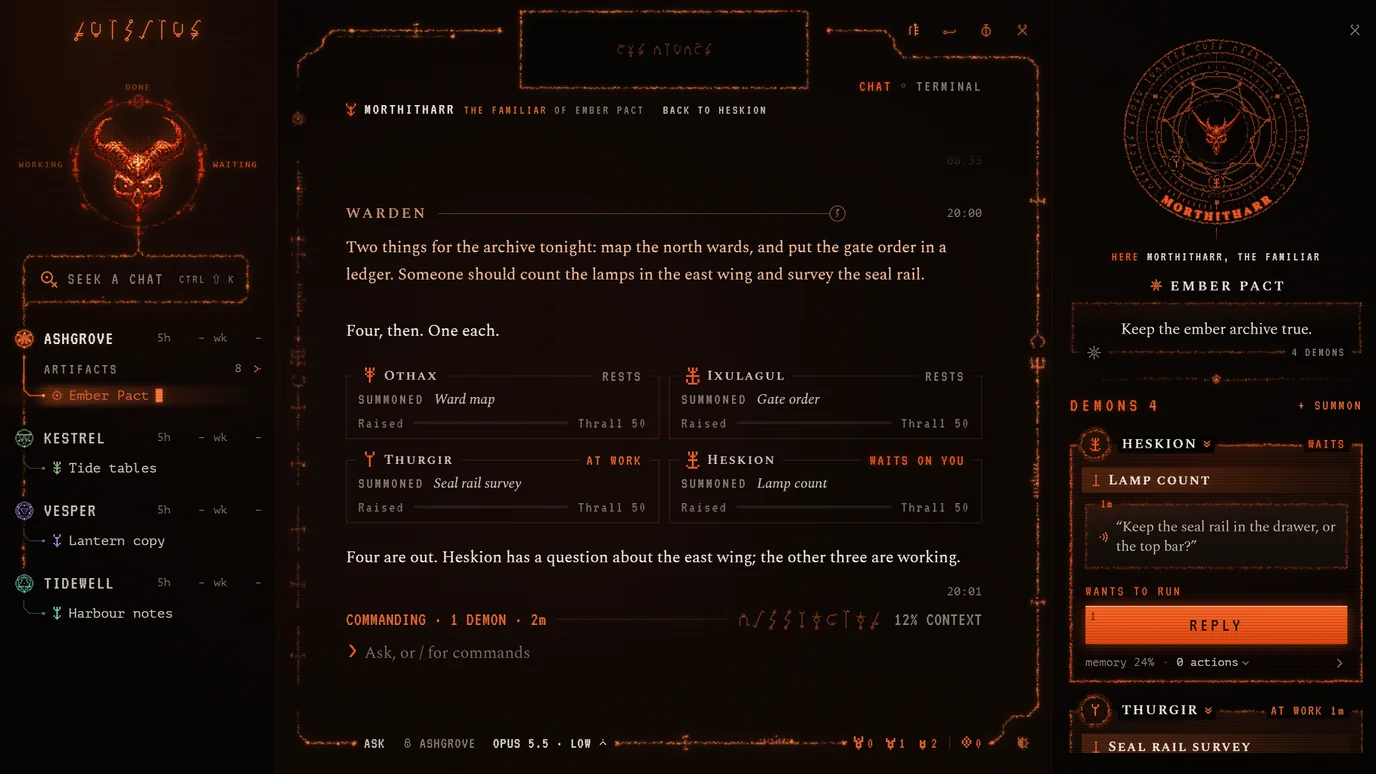
The Grimoire's window: realms down the left under the Familiar's head, the chat with its demons in the middle, the pact and its demons on the right
The Familiar’s head and the pact’s seal are the ember engine; the names are VT323, the talk is Spectral, the chat sits in the Faust frame. Every name in it is invented for the capture.
The Grimoire’s title, possessed
Possessed
The Grimoire’s title, resolving
Resolving
The Grimoire’s title, settled
Settled

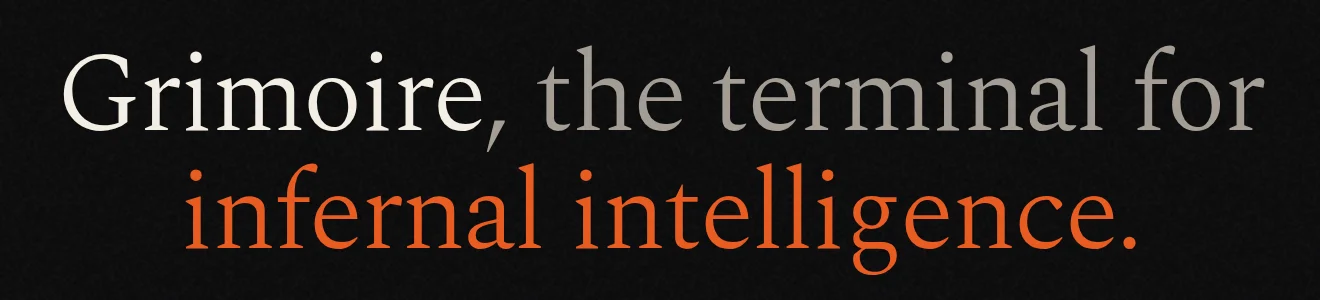
On the site the Grimoire’s name arrives possessed, every letter a glyph of the script, and settles into Latin in about three seconds.

Answer from everywhere

One of the app’s features, as the homepage draws it: the Grimoire runs on a server, a laptop or a phone. The screen is made of embers and keeps changing shape between the three, and your prompts rise round it as a demon’s speech in Infernal Script. Where the coil passes behind the screen, the script turns into plain words. It runs live.

04.3 The launch film

Thirty-three seconds that introduce it.

It opens on a question: why use agents when you can summon demons? The Grimoire’s lockup ignites over its own window and the seals break; then the Familiar, the legion of demons, a realm, and the answer from everywhere, on a computer and a phone. The lab binds its own: the Pact, the Oath and the Covenant land one by one, a white light turns to “Then work with angels.” and goes out, and a gate closes into the lab’s star.

Muted here. Its score was cut to the picture: every scene opens on the first beat of a bar.

From a 16 px tab to the door of the building.

The same star holds at every size and on every surface: the browser, paper, the wall, the feed.

The browser: the hand-cut 16 px star in the tab, over the site’s opening screen.
Vince Buyssens
Co-founder
infernalintelligence.com
The business card: bone type on pitch stock, the back all tile.
Infernal Intelligence
The door: the tile as a lit plaque on stone.
The LinkedIn banner: one lit window in a dark tower, a horned figure standing in it

The feed: the LinkedIn banner, the lab’s tower at night, one window lit, and in it a figure with horns.

The Grimoire mark, pitch on an ember tile: the solid page, three talons and the prompt

The house and its first instrument

Tile by tile, the lab’s star and the Grimoire’s solid page: two forms, never copies of each other’s parts, drawn in one language.

Infernal IntelligenceGrimoire
Project
Infernal Intelligence, an art project by Vince Buyssens and Peter Wellens
Design and direction
Vince Buyssens
Made with
AI models, for the images, the film and the code, under his direction
Disciplines
Brand identity, type, motion, web
Year
2026
Live
infernalintelligence.com